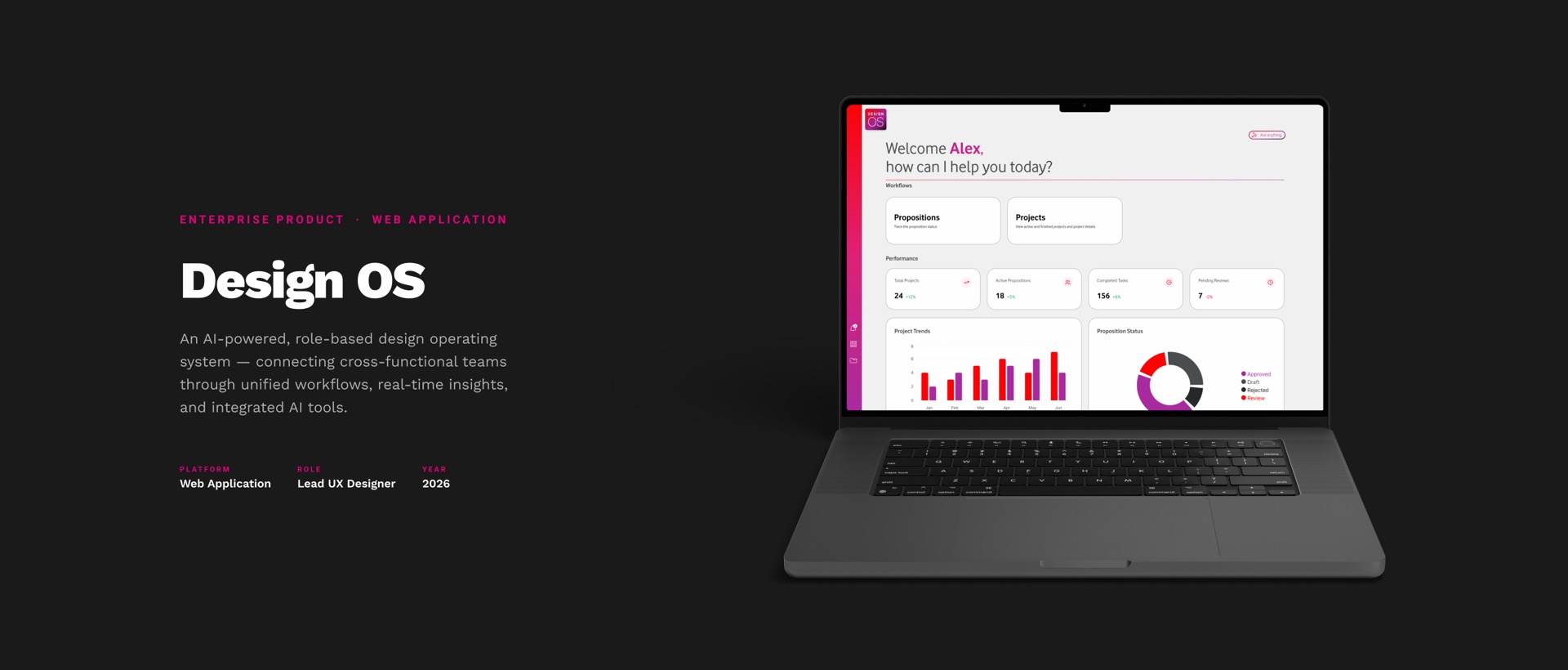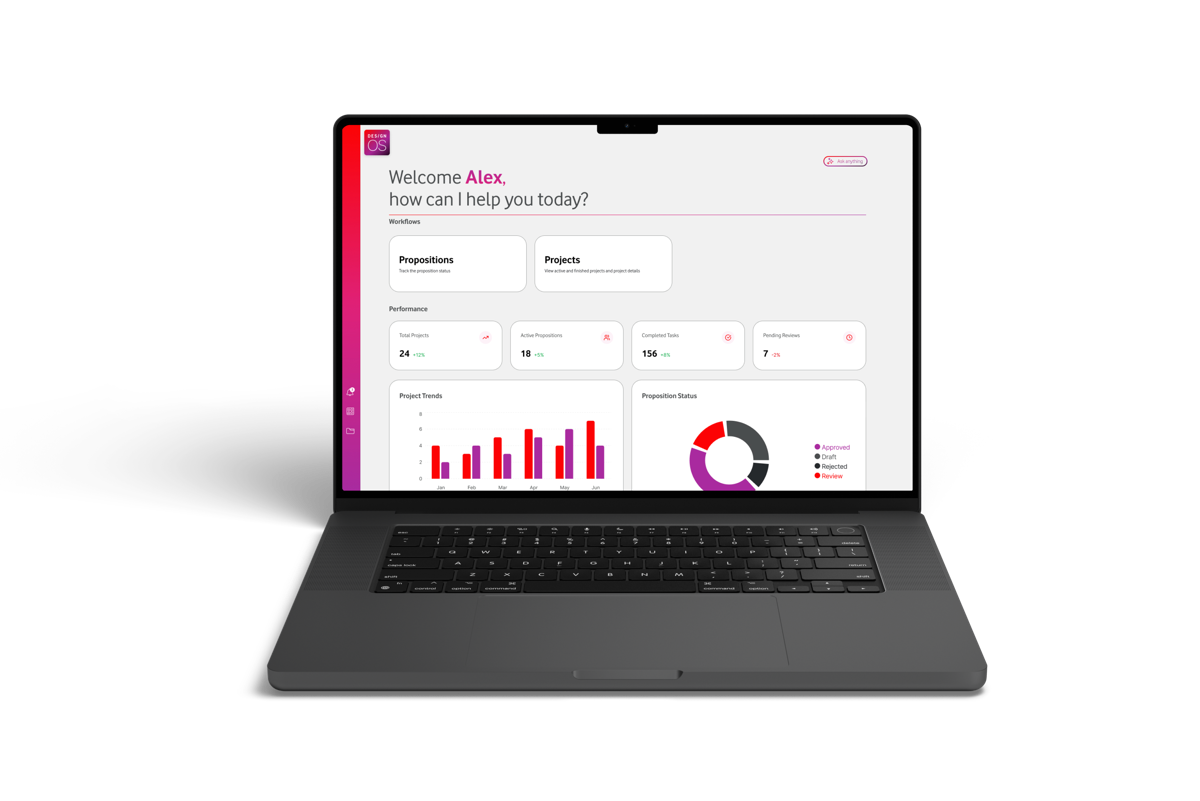
(AI-Powered Design Operating System)
Enterprise design, marketing, and product teams operated in complete silos — no shared workflows, no AI integration, and no unified visibility across projects and roles. Researchers, UX designers, content teams, and leads each used separate platforms. Handoff was manual and context was constantly lost.
Siloed Tools — No shared context across roles. Each team maintained its own systems, creating duplicate work and misaligned outputs.
No AI Integration — Teams had no structured way to leverage AI within their daily workflows — despite clear demand and growing tooling availability.
The Objective: Design a role-based AI operating system that unifies cross-functional teams — giving every role a tailored dashboard, a dedicated AI co-pilot, and shared visibility into projects in real time.
AI Co-Pilot for Every Role — Each dashboard ships with a role-specific AI Co-Pilot that surfaces insights, flags blockers, and suggests next steps — trained on the team's own project data.
Unified Project Intelligence — Real-time cross-team visibility: business leads see project status, designers see feedback queues, researchers see insight gaps — all from one source of truth.
14 Interviews Across 6 Roles — Mapped daily workflows, tool-switching friction, and unmet AI needs. Identified common pain points: context loss, duplicate work, no shared visibility.
6 Role Profiles — Business Leads, Design Leadership, UX & Service Design, Research, Technology, and Product — each with a tailored dashboard and dedicated AI co-pilot entry point.
| Phase | Action & Outcome |
|---|---|
| Discovery | 14 interviews across 6 enterprise roles. Mapped daily tool usage, switching friction, and unmet AI needs. Identified 6 core pain patterns shared across all roles. |
| Definition | Defined 6 distinct role profiles with overlapping shared needs. Built a unified IA that supports role-specific entry points while sharing a common data layer. |
| Design System | Built a scalable component library with role-aware colour coding, shared AI interaction patterns, and a token system supporting both light and dark contexts. |
| High-Fidelity Delivery | Delivered 40+ screens covering all six role dashboards — from brief creation and research synthesis through to design handoff and delivery tracking. |
6 User Roles Served — Business Leads, Design Leadership, UX & Service Design, Research, Technology, and Product — each with a tailored dashboard and dedicated AI co-pilot.
40+ Screens Designed — Full product lifecycle coverage across all six role dashboards — from brief creation and research synthesis through to design handoff and delivery.
Unified Intelligence Layer — A single data model powering role-specific views, eliminating duplicate reporting and enabling real-time cross-team visibility for the first time.
Platform
Web App
Roles
6
Screens
40+
Year
2026
The central architectural decision was how much to share vs specialise across six very different roles. We resolved this by building a single shared data layer with role-specific view compositions on top — meaning one source of truth, but six distinct interpretations of it.
AI integration required defining clear boundaries: the co-pilot suggests, humans decide. This principle shaped every AI touchpoint — preventing the system from feeling intrusive while still delivering genuinely useful, context-aware intelligence.
Have a project in mind? Let's talk.
Get In TouchOver the years I have worked for and cooperated with various companies from various industries.
Some of them can be found here:
Let's talk.
Unleashing brand potential through creative design and innovation.